Bomb the Song, Break the Internet: How Karaoke Disasters Became the Ultimate Content Strategy
There's an unwritten rule in karaoke culture that nobody talks about but everybody secretly understands: the worse the performance, the better the story. And in 2024, a great story isn't whispered between friends over lukewarm drinks — it's uploaded, captioned, and algorithmically served to seventeen million strangers before you've even made it back to your booth.
Welcome to the golden age of the karaoke fail.
The Anatomy of a Viral Karaoke Moment
Not all bad singing is created equal. There's a specific cocktail of ingredients that transforms a cringe-worthy mic drop into genuine internet gold. Think about it: a monotone rendition of "Happy Birthday" in an empty room? Forgettable. But a grown adult in a cowboy hat absolutely murdering Celine Dion's "My Heart Will Go On" while their friends lose their minds in the background? That's content.
The magic formula tends to involve a few key elements: total commitment from the performer, a wildly ambitious song choice, and at least one person in the crowd whose reaction could win an Emmy. The audience becomes as much a part of the video as the singer — those cutaways to a friend's horrified face or a stranger's involuntary applause are what push a clip from mildly funny to full-on viral.
TikTok's karaoke content ecosystem has exploded in recent years, with hashtags like #karaokenight and #karaokefail racking up billions of combined views. The platform's short-form format is almost tailor-made for the karaoke fail arc: setup, catastrophic attempt, chaotic resolution — all in under sixty seconds.
Real Fails, Real Fame
Some of the most beloved karaoke clips circulating online weren't accidents in the traditional sense. Take the genre of videos where someone confidently strides to the mic for a Mariah Carey classic and proceeds to hit approximately zero of the correct notes — but never once breaks character. The confidence is the punchline. The commitment is the comedy.
One clip that made the rounds heavily on Twitter and Instagram featured a man at what appeared to be a corporate holiday party attempting Guns N' Roses' "November Rain" — the full nine-minute version. He made it through roughly four minutes before the crowd started slow-clapping in a way that was equal parts cruel and affectionate. The video hit over two million views in a weekend. The guy reportedly got recognized at a Walmart in Ohio the following Tuesday.
Then there's the beloved subcategory of "wrong song" fails — moments where someone queues up what they think is a familiar banger and discovers, in real time, that they only knew the chorus. Watching someone confidently start a verse and then slowly dissolve into half-remembered syllables and hopeful humming is a comedic experience that transcends age, background, and taste in music.
The Creators Who Are Doing It on Purpose
Here's where it gets interesting. A growing number of content creators have figured out that karaoke bars are essentially free comedy stages with built-in props, lighting, and an audience of unsuspecting participants.
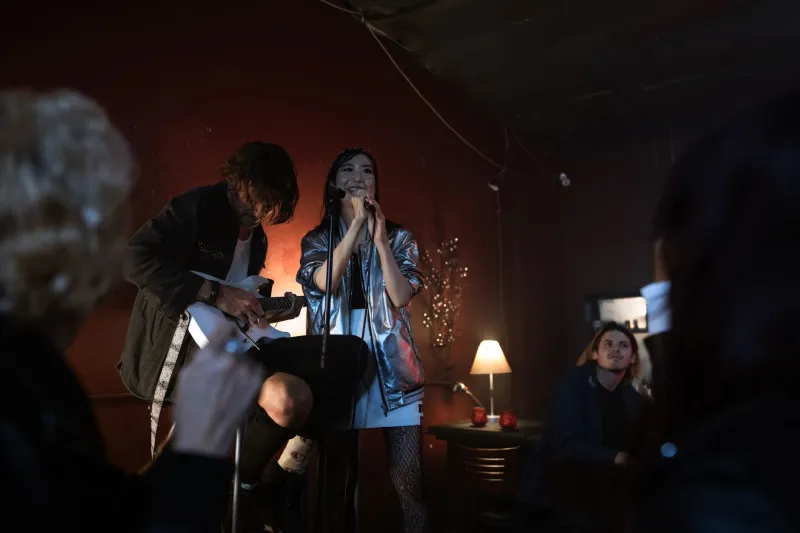
Creators in the entertainment and lifestyle space have started treating karaoke nights as content shoots. The strategy is deceptively simple: pick an outrageously difficult song, perform it with maximum theatrical energy, and make sure someone's phone is pointed at the room — not just the stage. The reaction economy is real, and karaoke delivers reactions on demand.
Some creators are even more deliberate about it. They'll go in groups, assign roles (the singer, the hype person, the reaction-cammer), and engineer moments designed to be clipped. One popular approach is the "bait and switch" — starting a song beautifully, lulling the crowd into thinking they're witnessing something special, then pivoting into absolute chaos by the second verse. The crowd's whiplash is the content.
As one lifestyle creator who posts regularly about nightlife experiences put it: "Karaoke is the only place where failing harder actually gets you more views. I've posted genuinely good performances that got three hundred likes. I posted a video of me forgetting the words to 'Don't Stop Believin'' and it got shared forty thousand times. The algorithm loves a disaster."
So You Want to Go Viral at Karaoke? Here's How to Engineer the Chaos
If you're thinking about turning your next karaoke night into a content opportunity, there are some practical moves that separate shareable moments from just regular embarrassing ones.
Pick a song that's bigger than you. Don't go for something in your wheelhouse. Reach for a song that requires a voice you don't have. Bohemian Rhapsody, anything by Beyoncé, "I Will Always Love You" — songs with reputations. The gap between expectation and delivery is where the comedy lives.
Commit completely. Half-hearted fails aren't funny — they're just sad. If you're going to crater, crater with your whole chest. Lean into every wrong note. Hold that off-key high note for an uncomfortable amount of time. The audience will respect the audacity even as they wince.
Think about your framing before you go up. Who's filming, and from where? A static shot of just the screen is a missed opportunity. You want the crowd in frame. You want the bartender's face. You want the couple in the corner who didn't sign up for this. Those peripheral reactions are what make a clip shareable rather than just watchable.
Let the moment breathe. Don't cut the video the second the song ends. Some of the best karaoke content comes in the aftermath — the applause that's slightly too enthusiastic, the friend who can't stop laughing, the stranger who walks over to pat you on the shoulder like you just survived something together.
Caption it with honesty. "I thought I could sing" hits differently than an ironic "Grammy-winning performance." Audiences reward self-awareness. They like knowing you're in on the joke.
The Deeper Truth About Why We Love This Stuff
There's something genuinely heartwarming buried underneath all the cringey glory of the karaoke fail genre. These videos keep going viral not just because they're funny, but because they're human. In a media landscape saturated with polished, filtered, algorithmically optimized perfection, watching a real person earnestly attempt something they're terrible at — and survive it — is weirdly comforting.
Karaoke has always been about permission. Permission to be loud, to be imperfect, to take up space in a room without having the credentials to justify it. When those moments go viral, they're not just getting laughs — they're spreading that permission to everyone watching from their couch, secretly wishing they could be that unhinged and free.
So next time you're at a karaoke bar and you feel the urge to play it safe with a song you actually know, consider the alternative. Pick the impossible song. Swing for the fences. Let the disaster happen naturally and let someone capture it.
Your worst performance might just be your best content.
KTV789 — Sing Loud, Have Fun, Anywhere You Are.