Mic Shy No More: How Karaoke Apps Are Quietly Transforming Introverts Into Stage Legends
If you told the average introvert that karaoke — that gloriously chaotic, public, attention-demanding activity — was about to become their favorite hobby, they'd probably laugh politely and then go hide in the bathroom for twenty minutes.
And yet, here we are.
Across the United States, a quietly significant cultural shift is underway. Thanks to the explosion of mobile karaoke apps and at-home KTV setups, the people least likely to ever grab a mic in public are now singing their faces off — just, you know, in private first. And then, slowly, not so privately anymore.
This is the introvert karaoke pipeline, and it is real.
The Problem With Traditional Karaoke (If You're Wired a Certain Way)
Let's be honest about what a typical karaoke bar asks of a shy person. You walk into a loud, unfamiliar room full of strangers. Someone hands you a songbook the size of a phone directory. At some point, your name gets called, a spotlight (metaphorical or literal) swings toward you, and you are expected to perform on demand — in front of people you don't know, singing words you may or may not remember, in a key that may or may not suit your voice.
For extroverts, this sounds like a Thursday night. For introverts, it sounds like a stress dream they've had multiple times.
The social anxiety research backs this up. According to the Anxiety and Depression Association of America, social anxiety disorder affects roughly 15 million American adults. Even for those who don't meet clinical thresholds, the fear of being judged or embarrassed in public is one of the most commonly reported social discomforts. Karaoke, in its traditional form, is basically a greatest-hits compilation of social anxiety triggers.
But strip away the audience? The pressure evaporates almost entirely.
The Rise of the Solo Session
The data on private karaoke is striking. KTV-style private room venues — where you book a booth with just your group — have been growing steadily across US cities for years, particularly in markets with large Asian-American communities where the format has long been mainstream. But the real game-changer has been the smartphone.
Apps like Smule, StarMaker, and KTV-style mobile platforms have logged enormous spikes in solo usage over the past few years. Industry observers noted a significant jump in single-user sessions during the pandemic years, but what surprised analysts was that the behavior stuck. People discovered that singing alone, at home, into their phone was genuinely enjoyable — and genuinely useful.
"I started using a karaoke app during lockdown just to have something to do," says Priya, 34, a software engineer from Austin who describes herself as "deeply, committedly introverted." "I did it at midnight with headphones so my roommates wouldn't hear me. Three months later I was doing it with the door open. A year later I went to an actual karaoke bar and sang in front of people. I cried a little. Proud tears."
Her trajectory is increasingly common.
Why the Low-Pressure Environment Works
From a psychological standpoint, the effectiveness of private practice as a confidence-building tool isn't surprising at all. It maps directly onto exposure therapy principles — the idea that gradual, controlled exposure to a feared situation reduces the anxiety response over time.
The private karaoke session functions as what therapists might call a "behavioral experiment" — a chance to test the feared outcome (embarrassment, judgment, failure) in a context where the stakes are essentially zero. When nothing bad happens — when you crack on a high note and the world doesn't end — your nervous system slowly recalibrates.
"The thing about introverts is that they often have very rich internal lives and genuinely enjoy music," notes one social psychology framework on personality and performance. "The barrier isn't the singing. It's the being-watched-while-singing. Remove the watching, and you've removed the barrier."
Apps take this further by adding features that ease the transition to social performance. Many platforms include options to share recordings with a small, chosen audience — friends, followers, or anonymous online communities — before ever stepping onto a physical stage. It's a graduated exposure ladder, built right into the interface.
Real Users, Real Glow-Ups
Devin, 28, from Portland, Oregon, spent two years using a mobile karaoke app exclusively before ever entering a karaoke bar. "I have pretty bad social anxiety," he explains. "But I love music. The app let me figure out what songs I was actually good at, what my range was, what I sounded like. By the time I went to a real venue, I wasn't guessing anymore. I knew my songs. That made all the difference."
For Keiko, 41, from Los Angeles, the journey went in a slightly different direction. A longtime karaoke avoider at work events and family gatherings, she downloaded a KTV-style app on a whim. "I started rating myself. Honestly. And I got better. And then I started sharing clips with my sister. And then my sister made me come to karaoke with her friends." She pauses. "I sang 'Total Eclipse of the Heart' in front of twelve people. I didn't die. It was incredible."
Tips for Using Private Sessions as a Stepping Stone
If you're an introvert curious about karaoke but not quite ready to go full stage goblin in public, here's a sensible progression that works:
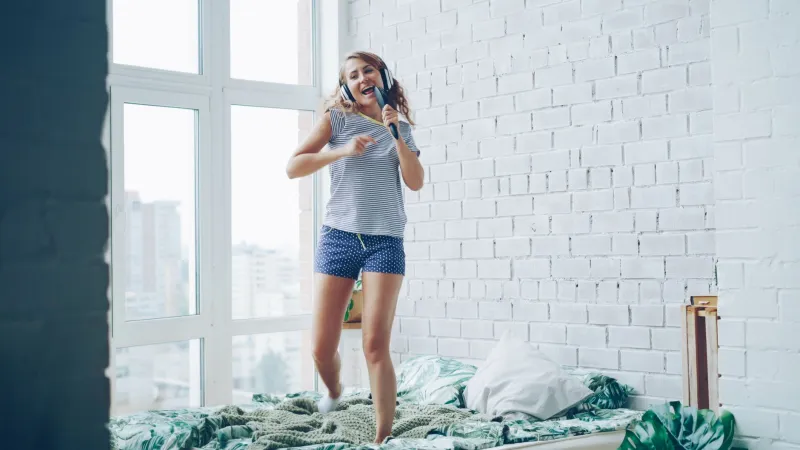
Start completely solo. Use headphones. Sing at whatever volume feels comfortable. This is about getting comfortable with your own voice, not performing for anyone.
Record yourself. Yes, it's uncomfortable the first time. Do it anyway. Hearing your own voice objectively is how you identify which songs actually suit you, and it builds a kind of self-familiarity that reduces anxiety.
Share with one trusted person. Send a clip to your most supportive friend. Not for validation — for practice at the feeling of being heard.
Try a private booth. Book a KTV-style private room with two or three close friends. No strangers, no open-mic energy — just a closed door, a big screen, and people who already like you.
Choose your first public song strategically. When you do eventually go to a public venue, pick a song you've sung a hundred times in private. The familiarity is a safety net.
Embrace the chaos. At some point, you're going to miss a lyric or crack on a note. The audience will cheer anyway. That's when it clicks.
The Bigger Picture
What's happening with introverts and karaoke apps is part of a broader cultural conversation about how technology can lower the barriers to social participation rather than replace it entirely. The endgame of the solo karaoke session isn't to stay in your bedroom forever — it's to get comfortable enough that the outside world feels a little less terrifying.
Karaoke, weirdly, might be one of the most democratic social activities out there. Nobody's expecting you to be good. The bar is literally just "tries." And when you've spent months in your living room figuring out that you can actually hold a note on the right song?
That bar feels a whole lot lower than it used to.
Sing loud, have fun, anywhere you are. Even if "anywhere" starts in your bathroom at 11pm with the door locked. That's a perfectly valid first step.